VIN Searches
How to Identify the Correct Toyota Spare Part Using VIN Number
Wrong parts destroy trust. Across MENA markets, Toyota vehicles sharing a model name can differ by factory, year, axle, engine, and options. The Vehicle Identification Number (VIN) is the most reliable starting point for spare-parts identification.
This guide explains what a VIN is, where to find it, why it matters commercially, how Toyota VIN structure works at a high level, and how Mosarat uses VIN data in RFQs.
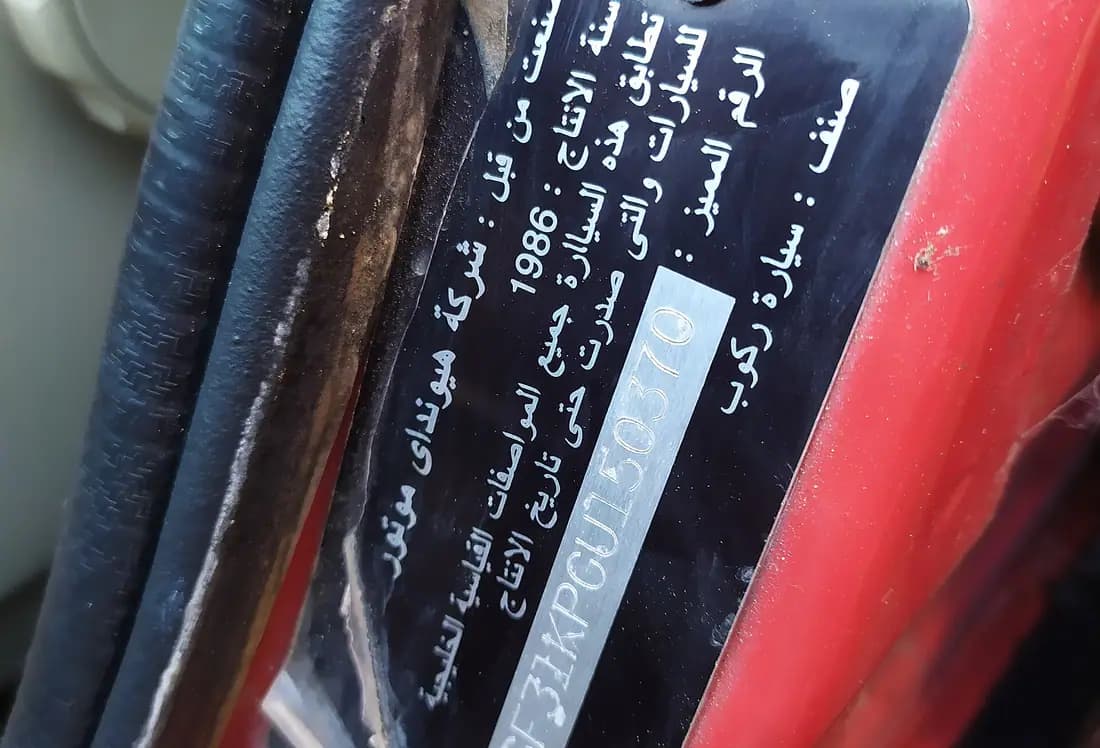
What Is a VIN?
A VIN is a 17-character code that uniquely identifies a vehicle. It encodes manufacturer, vehicle attributes, model year, plant, and serial information. For parts buyers, it is the key that unlocks the correct catalog application.
Introduced globally in the 1980s, the VIN standardized vehicle identification across borders. Before VIN, regional chassis stamps and inconsistent numbering caused sourcing chaos. Today, whether a Hilux was built in Thailand for African export or in Japan for GCC delivery, the VIN communicates these differences in a structured format that suppliers, insurers, registration authorities, and parts catalogs all reference.
From a commercial standpoint, the VIN reduces guesswork. Instead of triangulating from model year, trim level, and verbal descriptions, a single code anchors the entire transaction. This precision becomes critical when a workshop in Nairobi orders suspension parts for a fleet of Land Cruisers that operate across East Africa, or when a Dubai-based exporter consolidates multi-model inventory for a West African dealer group.
Where To Find the VIN
Common locations include:
- Dashboard plate visible through the windshield on the driver side
- Driver door jamb sticker
- Registration and insurance documents
- Service booklets and import paperwork
- Some engine bays and frame locations depending on model
Photo tips for RFQs
Photograph the VIN plate clearly, avoid glare, and include a second photo of the vehicle odometer or chassis stamp if the plate is damaged. Illegible VINs delay sourcing.
Why VIN Matters for Spare Parts
Ordering by “Hilux 2018 brake pads” is a guess. Regional braking packages, ABS variants, and wheel sizes change OE numbers. The cost of a wrong shipment — freight both ways, downtime, and customer frustration — usually exceeds the minutes spent capturing a VIN.
- Reduces incorrect aftermarket cross-references
- Captures market-specific emissions and cooling differences
- Helps distinguish facelifts that look similar
- Supports genuine parts authenticity workflows
- Prevents costly misidentification of ABS modules, brake boosters, and hydraulic components
- Clarifies diesel vs petrol engine variants when badges are removed or replaced
- Essential for electric power steering vs hydraulic steering cross-checks
Toyota VIN Structure Explained (Practical Buyer View)
Without turning this into a cryptography lesson: characters identify world manufacturer, vehicle descriptors, a check digit, model year, plant, and the sequential production number. Buyers do not need to memorize the map — they need to provide the full 17 characters accurately.
For practical reference, a Toyota VIN from a 2016 GCC-market Prado might start with JTEBH or JTFBH, signaling Toyota's world manufacturer identifier, vehicle type, and market intent. Mid-stream characters encode engine type, body style, and restraint systems. The tenth character reveals model year (G for 2016, H for 2017, J for 2018, and so on in sequence). The eleventh character identifies the assembly plant — J often means Japan, while other letters point to Thailand, Indonesia, or other Toyota production hubs.
The last six digits are the vehicle's sequential production number. This serial ensures no two vehicles share the same VIN even if they rolled off the same line in the same week. For parts sourcing, this granularity matters less than the earlier characters that encode market, drivetrain, and equipment packages.
Beware of letter/number confusion (O/0, I/1). If a character is uncertain, say so in the RFQ rather than inventing a digit. A single wrong character can route the inquiry to the wrong model family, wasting time and requiring re-quotation.
Using VIN To Identify Parts: Workflow
A practical flowchart in words:
- 1. Capture full 17-character VIN and destination country
- 2. Describe the parts needed (OE number if known, or photos of old parts)
- 3. State genuine / OEM / aftermarket preference
- 4. Mosarat matches against UAE supplier catalogs and stock
- 5. You receive an itemized quote with labeled quality tiers
- 6. Approve, pay, and ship — revise if vehicle data was incomplete
How Mosarat Helps
Submit VIN on the VIN page or inside an RFQ. Our team uses VIN-assisted identification plus supplier confirmation before locking commercial quotes. WhatsApp is available for urgent clarification when plates are unclear or vehicles are modified.
When you submit a VIN through /vin or attach it to an RFQ, Mosarat cross-references UAE supplier catalogs that hold market-specific fitment data. If a part number returns multiple options — say, two different brake master cylinder variants for the same model year — the VIN narrows the choice to the one that shipped with your specific build. This two-step process (VIN decode + supplier verification) protects both sides from catalog errors and reduces the need for multi-round corrections.
VIN vs Chassis Number: What's the Difference?
Some markets and older vehicles use the term "chassis number." In most modern contexts, VIN and chassis number are interchangeable — both refer to the 17-character identifier. However, older Toyota vehicles (pre-1980s) and certain regional registrations may display shorter alphanumeric codes that pre-date the standardized 17-character VIN.
If your registration lists a code shorter than 17 characters, note that in the RFQ and include photos of any frame stamps or engine-bay stickers. Mosarat can often identify the vehicle by cross-referencing model, year, and available partial codes, though the process takes longer and carries higher misidentification risk.
For any Toyota manufactured after the mid-1990s, expect a full 17-character VIN. If you cannot locate it, that is a red flag worth investigating before ordering expensive parts.
Parts Most Affected by VIN-Specific Variations
Not all parts require VIN precision. Generic consumables like wiper blades, cabin air filters for standard HVAC, and universal-fit floor mats rarely need VIN confirmation. But the following categories see frequent mismatches without VIN:
Brake System Components
Brake pads, rotors, calipers, master cylinders, brake boosters, and ABS modules vary by market package, wheel size, and load rating. GCC-spec Hilux might use different front caliper brackets than African-market counterparts.
Suspension and Steering
Shock absorbers, coil springs, upper and lower control arms, steering racks, and power-steering pumps differ by load class, lift, and regional road-compliance standards. VIN identifies which suspension package was installed at the factory.
Engine and Cooling
Radiators, water pumps, thermostats, cooling fans, and fan clutches vary by engine variant and climate package. A hot-climate radiator for Saudi Arabia has more core rows than a temperate-market unit. VIN captures these cooling differences.
Electrical and Electronics
Alternators, starters, ECU modules, and wiring harnesses can differ by emissions standard, fuel type (diesel vs petrol), and accessory packages. VIN prevents ordering a diesel-specific alternator for a petrol engine.
Transmission and Drivetrain
Clutch kits, flywheels, axle shafts, differential components, and transfer-case parts vary by transmission type (manual vs automatic) and drive configuration (2WD vs 4WD). VIN clarifies these critical drivetrain splits.
Regional VIN Scenarios Across MENA and Africa
Understanding how VIN usage varies by region helps buyers prepare better documentation:
GCC Markets (UAE, Saudi Arabia, Kuwait, Qatar, Oman, Bahrain)
Most vehicles registered post-2000 have clean VIN documentation. Registration cards list the VIN prominently. Parts sourcing in GCC is usually straightforward when VIN is provided.
North Africa (Egypt, Libya, Tunisia, Algeria, Morocco)
A mix of European, Japanese, and local-assembly vehicles. Older grey-import units may have incomplete VIN records. Suppliers often request photos of the vehicle and engine bay alongside VIN to confirm market origin.
East Africa (Kenya, Uganda, Tanzania, Ethiopia)
High volume of used Japanese imports (often via Mombasa port). VIN plates may be weathered or replaced. Buyers should photograph the chassis stamp near the front suspension or engine bay as backup.
West Africa (Nigeria, Ghana, Senegal, Côte d'Ivoire)
Mix of new vehicles and older used imports from Europe and Asia. VIN data quality varies. Clear photos of the VIN plate plus vehicle registration improve sourcing accuracy.
South Asia Export (Pakistan, Bangladesh, Sri Lanka)
Many vehicles share platforms with GCC models but may carry different market codes in the VIN. Always specify destination country alongside VIN to ensure parts match local specifications.
How to Photograph a VIN for RFQ Submission
A poor VIN photo causes delays. Follow these steps:
- Clean the VIN plate or dashboard area with a dry cloth to remove dust and glare
- Photograph in natural daylight or well-lit indoor conditions; avoid direct sun causing reflections
- Hold the camera parallel to the plate to prevent perspective distortion that makes characters unreadable
- Capture the full 17-character sequence in one clear frame
- Take a second zoomed-out photo showing the VIN location (dashboard or door jamb) for context
- If the plate is damaged or illegible, photograph any secondary chassis stamps (engine bay, frame rail) and note the damage in your RFQ message
Common VIN Mistakes and How to Avoid Them
Even experienced buyers make VIN errors that delay sourcing or cause wrong-part shipments:
Confusing O and 0, I and 1
Standard VINs do not use the letters I, O, or Q to avoid confusion with 1 and 0. If you think you see an I or O, it is probably 1 or 0. When in doubt, photograph the plate and let the supplier decode rather than guessing.
Partial VIN Submission
Sending only the last 8 digits or the visible dashboard portion may work for rough guidance, but it increases wrong-part risk. Always capture all 17 characters from the door jamb sticker or registration if the dashboard plate is incomplete.
Assuming VIN Equals Part Compatibility Without Market Context
VIN tells you what the vehicle was when it left the factory. It does not capture aftermarket modifications like lift kits, brake upgrades, or engine swaps. Always mention modifications in your RFQ even when providing VIN.
Not Specifying Destination Country
A Hilux VIN might decode correctly, but if the parts are destined for Algeria and the vehicle was originally sold in Kuwait, emissions and cooling specifications may differ from what the destination market requires. Always state where the vehicle operates.
VIN and Genuine Parts Verification
VIN plays a role in genuine parts authentication. Toyota genuine parts sold through authorized channels often include packaging that references VIN compatibility. When a supplier quotes genuine parts, the VIN ensures the part number matches Toyota's original equipment list for that specific build.
This traceability protects workshops and fleets from counterfeit or mislabeled inventory. If a part arrives and the packaging lists a different VIN range or model code, that is a red flag worth investigating before installation.
Mosarat sources from UAE suppliers who maintain stock linked to Toyota's regional catalog systems. When you provide VIN, we verify the proposed part numbers against these catalogs before finalizing the quote, adding a layer of quality control that ad-hoc suppliers often skip.
Exporting Parts from UAE Using VIN Data
Dubai and the wider UAE serve as a global hub for Toyota parts distribution. Suppliers here stock inventory for GCC, African, Asian, and European markets. VIN helps exporters select the correct regional variant when consolidating multi-destination shipments.
For example, a Dubai exporter preparing a container for Nairobi might include parts for ten different Hilux variants. VIN ensures each line item matches the intended vehicle, reducing the risk of costly mix-ups when the container reaches the destination and parts are distributed to different workshops.
Customs and import documentation also benefit from VIN precision. Some African and South Asian countries require import permits that reference vehicle VIN or chassis numbers. Accurate VIN data on the commercial invoice and packing list speeds clearance and reduces the chance of holds at the port.
Frequently asked questions
What is the difference between OEM and genuine Toyota parts?
Genuine Toyota parts are sold through Toyota channels with Toyota branding and packaging. OEM usually means the same or equivalent manufacturer production for Toyota without necessarily carrying the Toyota retail brand path. For critical safety and engine parts, Mosarat quotes both options clearly so buyers can choose by warranty, price, and application.
Can I order Toyota parts by VIN?
Yes. Share the 17-character VIN on /vin or in your RFQ. Mosarat uses VIN plus catalog references to reduce fitment errors caused by regional market variations.
How long does shipping take from the UAE?
GCC road or air express often lands in a few days once goods are picked and cleared. Africa and South Asia lanes vary by mode — air for urgent lines, sea for volume. Quotes include expected timelines for your destination.
Are aftermarket parts reliable?
Quality aftermarket from established makers can be reliable for filters, many suspension wear items, and consumables when the brand and application are verified. We do not push anonymous no-name stock for safety-critical roles.
Do you ship internationally?
Yes. Mosarat exports from Dubai across the Middle East, Africa, and South Asia with air and sea options depending on urgency and carton volume.
Do you supply workshops and dealers only?
No. We serve dealers, workshops, fleets, procurement teams, vehicle owners, and importers. Quote format and packaging can be adapted to B2B or individual needs.
How fast can I get a quote?
Most complete RFQs receive an itemized response in about 30 minutes during UAE business hours. Incomplete part lists or missing vehicle data may take longer.
What payment methods do you accept?
Bank transfer and Stripe checkout are available after you accept a quotation in the portal. Payment terms for recurring dealer accounts can be discussed with sales.
Is a partial VIN enough?
Sometimes for rough guidance, but full VIN is strongly preferred. Partial data increases wrong-part risk on brakes, electronics, and drivetrain.
Can you decode VIN without ordering?
Yes for identification support tied to a quote request. Use /vin to start.
What if my vehicle is modified?
Tell us about lifts, brake upgrades, or non-stock wheels. VIN alone cannot see aftermarket modifications.
Do African and GCC Hilux trucks share parts?
Not always. Market packages differ — VIN and catalog confirmation prevent assumptions.
Can dealers send multiple VINs?
Yes. Batch RFQs are common for workshops and fleet procurement.
What if the VIN plate is missing?
Use registration documents and any chassis stamps; note uncertainty so we can flag higher verification needs.
Does VIN help with aftermarket cross-reference?
Yes. Better vehicle identity improves aftermarket application matching and reduces returns.
Conclusion
VIN-first sourcing is the professional standard for Toyota spare parts across MENA. It protects workshops, fleets, and importers from costly misfits.
The VIN eliminates the silent variations that cause parts mismatches across regional markets. For buyers sourcing Toyota parts from UAE suppliers, VIN submission should be standard practice on every RFQ — not an optional extra. The minutes spent photographing a VIN plate and including it in the procurement workflow save days or weeks of delay when wrong parts must be returned and reshipped.
Mosarat's UAE procurement network integrates VIN decoding with supplier catalog systems, providing a two-layer verification process that catches errors before parts are picked and packed. This reliability is especially critical for international buyers who cannot easily return shipments and for fleet operators who cannot afford vehicle downtime while corrections are made.
Upload your VIN to Mosarat, request a quote, or message WhatsApp — we will identify compatible parts and price them from UAE wholesale supply.