Toyota Chassis Lookup
Toyota Chassis Number Lookup
Toyota Chassis Number Lookup sourcing from UAE connects buyers with parts identification services using VIN or chassis number decoding. Dubai's concentrated auto parts ecosystem and catalog integration make it the Middle East's premier hub for VIN-assisted parts sourcing to workshops, fleet operators, dealers, and vehicle owners across GCC, Africa, and South Asia.
Mosarat Auto Parts provides chassis number lookup services that decode Toyota VINs against manufacturer catalogs, identify correct part numbers, and source genuine, OEM, and aftermarket options from vetted UAE wholesale suppliers with competitive pricing and international shipping.
Chassis number lookup eliminates guesswork in parts identification. Across MENA and African markets, workshops deal with Toyota vehicles from multiple source markets (Japan, GCC, Europe, Thailand) that share model names but differ in specifications. A 17-character chassis number (VIN) reveals the exact build configuration, allowing UAE suppliers to match parts with precision and avoid costly misfits.
This comprehensive guide covers chassis number lookup workflows, parts identification best practices, UAE sourcing advantages using VIN data, international shipping logistics, and the complete RFQ process for procurement teams and workshop managers seeking reliable VIN-assisted parts sourcing from Dubai.
Why UAE for Toyota Chassis Number Lookup
Dubai concentrates authorized distributors, regional aftermarket agents, and specialist importers serving Middle East, African, and Asian trade lanes. For buyers seeking VIN lookup for Toyota vehicles, UAE sourcing offers unmatched availability depth, competitive wholesale pricing, and supply chain speed that single-market suppliers rarely achieve.
GCC-spec VIN lookup differ from other regional variants with enhanced specifications suited to extreme heat, humidity, sand, and dust. VIN-based verification prevents costly fitment errors caused by market-specific engineering variations.
Why Choose Mosarat Auto Parts
- Genuine, OEM-equivalent, and verified aftermarket VIN lookup clearly labeled by quality tier and origin
- VIN verification to match specific chassis configurations and avoid compatibility errors
- Expert procurement team with direct access to UAE wholesale networks and authorized distributors
- Competitive pricing leveraging Dubai's concentrated supply ecosystem
- International shipping to GCC, Levant, Africa, and South Asia with full customs documentation
- WhatsApp support and online RFQ portal for fast itemized quotes typically within 30 minutes
Toyota Chassis Number Lookup Categories and Specifications
Below are key specifications and sourcing considerations for VIN lookup. Prices vary by vehicle model, generation, quality tier, and destination — request a live UAE quote for accurate pricing and lead times.
Genuine Parts
Factory-authorized VIN lookup with manufacturer branding, warranty support, and guaranteed fitment. Best for safety-critical applications, customer-facing repairs, and vehicles under warranty. Premium pricing offset by reliability and warranty coverage.
OEM and Premium Aftermarket
Equivalent manufacturing quality from original equipment suppliers or established brands. Mid-range pricing (30-50% savings vs genuine) with strong quality consistency when brands are verified. Suitable for fleet operations and high-mileage vehicles.
Economy Aftermarket
Budget-focused VIN lookup from various manufacturers. Lowest pricing (50-70% savings vs genuine) with variable quality depending on brand reputation. Best for non-critical applications, older vehicles, or price-sensitive fleet operations willing to accept higher replacement frequency.
Genuine vs OEM vs Aftermarket Decision Framework
Choosing between genuine and aftermarket VIN lookup depends on vehicle use, budget constraints, warranty requirements, and risk tolerance. Safety-critical systems warrant genuine or carefully verified OEM brands. Wear items and consumables can safely use quality aftermarket when brand reputation and application are confirmed.
| Factor | Genuine | OEM / Premium | Economy |
|---|---|---|---|
| Price | Highest | Mid-range | Lowest |
| Quality consistency | Highest | High when verified | Variable |
| Warranty clarity | Strong | Brand-dependent | Weak/absent |
| Best use | Safety-critical, warranty | Fleet operations | Budget-constrained |
VIN Verification for Accurate Fitment
Toyota vehicles are sold across multiple markets with region-specific specifications, cooling packages, and engineering revisions. A vehicle built for GCC heat differs substantially from European or Asian variants even when model year appears identical.
Mosarat uses VIN (17-character chassis number) plus manufacturer catalog cross-references to identify exact specifications and avoid fitment errors. Upload your VIN via /vin or include it in your RFQ for generation-accurate, market-specific VIN lookup quotes.
UAE as Strategic Sourcing Hub
Dubai's auto parts ecosystem concentrates wholesale suppliers, authorized distributors, and freight forwarders serving GCC, African, and South Asian markets. For buyers in Saudi Arabia, Kuwait, Qatar, Bahrain, Oman, Egypt, Jordan, and beyond, UAE sourcing provides availability depth and competitive pricing.
Mosarat operates within this network: RFQs matched to vetted suppliers, quoted with transparency (genuine/OEM/aftermarket clearly labeled), exported with complete customs documentation.
What Is a Chassis Number and Why It Matters
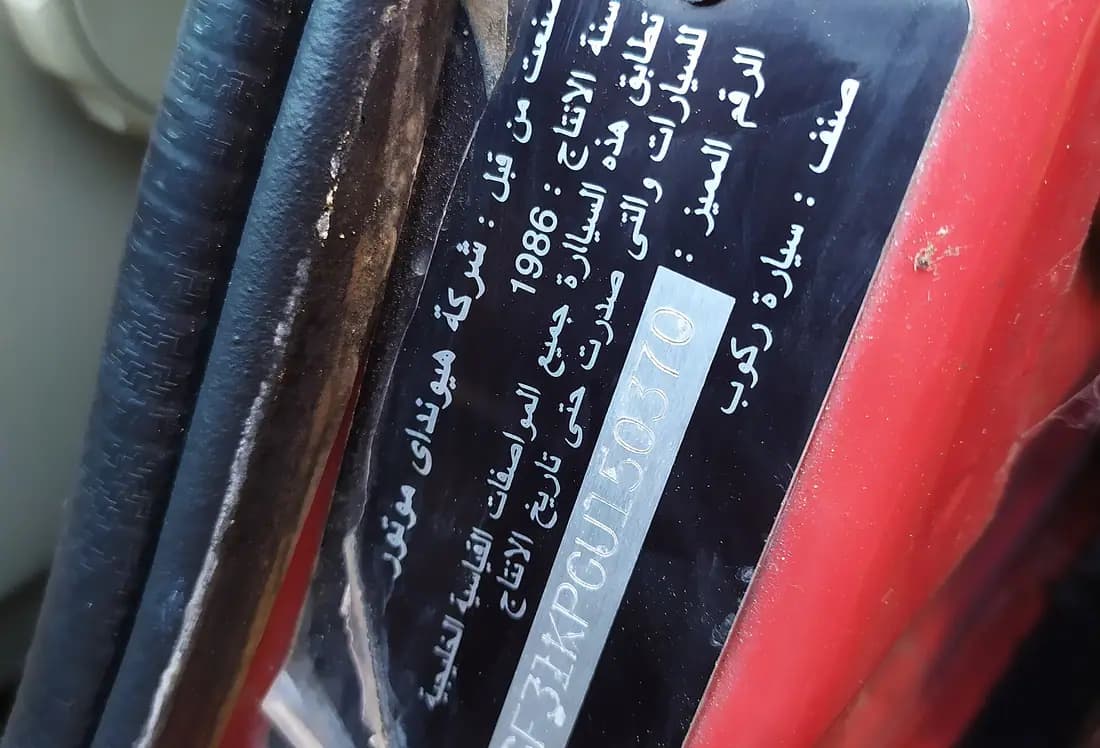
The chassis number (also called VIN or Vehicle Identification Number) is a unique 17-character code stamped on every modern Toyota vehicle. It encodes manufacturer identity, model code, engine type, production plant, model year, and sequential production number.
For parts sourcing, the chassis number is the most reliable identifier. Model names alone are insufficient — a 2017 Hilux sold in Kenya may have different brakes, suspension, or electrical systems than a 2017 Hilux sold in Saudi Arabia, even though both are called "Hilux 2017." The chassis number reveals these differences.
Chassis number lookup services decode the VIN and cross-reference it against manufacturer catalogs to identify compatible parts. This prevents expensive mistakes like ordering the wrong brake calipers or ECU modules that won't fit or function.
Where to Find Your Toyota Chassis Number
Common chassis number locations on Toyota vehicles:
- Dashboard plate visible through the windshield on the driver side (most modern vehicles)
- Driver door jamb sticker showing VIN, tire pressures, and paint code
- Vehicle registration document and insurance papers
- Service booklet and import/export documentation
- Engine bay firewall or frame rail (stamped on some models)
- Chassis rails near front suspension (useful when dashboard plate is missing)
Photography Tips for RFQs
When submitting a chassis number for parts lookup, photograph the VIN plate clearly in good lighting. Avoid glare, shadows, and perspective distortion. If the plate is damaged or illegible, photograph any secondary chassis stamps and note the damage in your RFQ so suppliers can request additional verification.
How Chassis Number Lookup Works in Practice
Step 1: Customer provides 17-character chassis number plus description of required parts (brake pads, water pump, alternator, etc.).
Step 2: Mosarat decodes the chassis number using electronic parts catalogs that reveal model code, engine type, market specification, and production date.
Step 3: Decoded data is cross-referenced against UAE supplier inventory to identify compatible part numbers in genuine, OEM, and aftermarket tiers.
Step 4: Customer receives an itemized quotation with part numbers, quality tiers, pricing, and lead times. If multiple options exist (e.g., two different brake pad variants for transitional model years), Mosarat clarifies which variant matches the specific build.
Step 5: Customer approves quote, parts are sourced, and shipment proceeds with VIN-referenced documentation for customs.
Chassis Number vs Model Code: Understanding the Difference
Chassis number (VIN) is a unique identifier for one specific vehicle. Model code is a shorter alphanumeric designation (like GRJ150, KUN25, ACV40) that identifies a vehicle platform or generation.
Model codes are useful for general parts research but less precise than chassis numbers. For example, all 2010-2013 Land Cruiser Prado 150 series share the model code GRJ150, but individual vehicles within that range may have different engines, suspension packages, or market-specific features. The chassis number distinguishes these individual builds.
When requesting parts from UAE suppliers, provide the full 17-character chassis number rather than just the model code. If you only have the model code, suppliers may request additional information (photos, year, engine size) to narrow down the exact specification.
Common Chassis Number Decoding Mistakes
Confusing the letter O with the number 0, or the letter I with the number 1. Standard VINs do not use I, O, or Q to avoid this confusion. If you see what looks like an I or O, it's probably 1 or 0.
Submitting partial chassis numbers (only the last 8 digits) instead of the full 17 characters. Partial numbers reduce identification accuracy and increase wrong-part risk.
Assuming chassis number lookup eliminates the need to specify destination market. Always state where the vehicle currently operates, as imported vehicles may need parts that match local regulations rather than original market specifications.
Not mentioning aftermarket modifications. Chassis number reveals factory configuration but cannot see lift kits, brake upgrades, or engine swaps done after the vehicle was sold.
Chassis Number Lookup for Grey-Import Vehicles
Grey-import vehicles (imported used from Japan, Europe, or elsewhere without going through official dealer channels) are common across Africa and parts of MENA. These vehicles often lack local service history, and workshops may be uncertain about specifications.
Chassis number lookup is especially valuable for grey imports. The VIN reveals the vehicle's original market (Japanese domestic, European export, Middle East export, etc.), which determines cooling specs, emissions hardware, and parts compatibility.
Mosarat's UAE suppliers see high volumes of grey-import Land Cruisers, Hilux trucks, and Prados. Our catalog systems include Japanese, European, and GCC market data, allowing accurate parts identification even for vehicles originally sold outside the Middle East.
Using Chassis Numbers for Multi-Vehicle Fleet RFQs
Fleet operators managing mixed Toyota inventories benefit from chassis number-based RFQs. Rather than describing each vehicle by model name, year, and trim level, submit a list with chassis numbers and required parts.
This approach reduces errors: the supplier decodes each chassis number and sources the correct parts for each vehicle without relying on verbal descriptions or assumptions. For workshops servicing customer vehicles from diverse import sources, chassis number lookup simplifies procurement and reduces return rates.
Customs and Export Documentation with Chassis Numbers
Including chassis numbers on commercial invoices and packing lists benefits buyers in markets where import permits or vehicle registration systems cross-reference parts against VINs. Some African countries require import documentation to list the chassis number of the destination vehicle, especially for high-value components like engines, transmissions, or electronics.
Mosarat includes chassis numbers on export documents when requested, ensuring compliance with destination-country import regulations and facilitating smooth customs clearance.
Chassis Number Lookup for Rebuilt and Salvage Vehicles
Rebuilt vehicles (repaired after accidents or salvage) may have chassis number plates that are damaged, replaced, or missing. For these vehicles:
Check registration documents for the full chassis number. If the VIN plate is missing but the registration lists a chassis number, that's sufficient for parts lookup. Photograph the registration document and include it with your RFQ.
Look for secondary chassis stamps on the firewall, frame rails, or engine bay. These backup stampings often survive accidents that destroy dashboard plates.
Note any modifications done during rebuild: suspension lifts, engine swaps, or brake upgrades that change parts requirements beyond what the original chassis number indicates.
Mosarat can assist with parts identification for rebuilt vehicles, but accuracy depends on clear communication about modifications and availability of backup chassis identification.
Future of Chassis Number Systems: Digital VIN and Connected Vehicles
As vehicles become more connected, chassis number systems are evolving:
Digital VIN: Some newer vehicles store VIN electronically in multiple control modules, making it harder to tamper with or counterfeit. Parts suppliers may soon access VIN data directly from vehicle telematics systems.
Blockchain VIN tracking: Emerging technologies use blockchain to create tamper-proof vehicle history records linked to chassis numbers, improving parts authenticity verification and reducing fraud.
For now, the physical 17-character chassis number remains the standard across UAE and global parts trade. Buyers should continue providing VIN for every parts order, and suppliers should continue verifying VIN against manufacturer catalogs before quoting.
Chassis Number Lookup for Grey Import Vehicles
Grey-imported Toyota vehicles (parallel imports from Japan, Europe, or other non-GCC markets) present unique challenges for parts sourcing because their specifications may not match local dealer inventories. Chassis number lookup becomes essential for identifying correct parts compatible with these non-standard builds.
UAE suppliers experienced with grey imports maintain broader catalog access spanning Japanese domestic market (JDM), European, and other regional specifications. When submitting chassis numbers for grey-import vehicles, inform the supplier of the vehicle's origin market to ensure catalog selection accuracy and prevent ordering GCC-spec parts incompatible with the vehicle's actual build. For workshops servicing mixed-market vehicle populations, VIN-based procurement eliminates guesswork and reduces costly returns.
International Shipping Process
- GCC destinations: Road or air express typically delivers in 2-5 days once picked and cleared
- Egypt, Jordan, Levant: Air for urgent parts; sea freight for volume orders
- Africa & South Asia: Air for critical downtime; sea consolidation for recurring orders
- Customs documentation: Commercial invoices, packing lists, certificate of origin, HS codes included
- Freight quotes: Delivery timelines and costs stated clearly based on mode and destination
How to Request a Quote
- Step 1: Gather VIN or chassis number, model year, engine type, and mileage context
- Step 2: List required VIN lookup with OE numbers if available, or clear descriptions plus photos
- Step 3: Specify destination country and preferred shipping mode (road, air, sea)
- Step 4: Define quality policy: genuine-only, mixed basket, or price-led on consumables
- Step 5: Submit via /quote form, WhatsApp, or email
- Step 6: Receive itemized AED quotation with lead times (typically 30 minutes)
- Step 7: Approve quote, pay via bank transfer or Stripe, receive dispatch tracking
Frequently asked questions
What is the difference between OEM and genuine VIN lookup?
Genuine parts sold through authorized channels with manufacturer branding. OEM means equivalent production without necessarily carrying retail brand path. Mosarat quotes both clearly labeled.
Can I order VIN lookup by VIN?
Yes. Share 17-character VIN on /vin or in RFQ. Mosarat uses VIN plus catalog references to reduce fitment errors.
How long does shipping take from UAE?
GCC road/air often lands in 2-5 days. Africa and South Asia vary by mode — air 5-10 days, sea 3-6 weeks.
Are aftermarket VIN lookup reliable?
Quality aftermarket from established manufacturers can be reliable when brand and application verified. Safety-critical components warrant genuine or proven OEM.
Do you ship internationally?
Yes. Mosarat exports from Dubai across Middle East, Africa, and South Asia with air and sea options.
Do you supply workshops only?
No. We serve dealers, workshops, fleets, procurement teams, vehicle owners, and importers.
How fast can I get a quote?
Most complete RFQs receive itemized response in about 30 minutes during UAE business hours.
What payment methods accepted?
Bank transfer (AED, USD, EUR) and Stripe checkout available after quote approval.
What should I prepare before requesting pricing?
Prepare VIN, part numbers if known, destination country, quality preference, urgency. Photos help when numbers worn.
Do you offer warranty?
Warranty terms depend on part type and quality tier. Genuine parts carry manufacturer warranty via authorized channels.
Can you source hard-to-find parts?
Yes. UAE network includes distributors and specialist importers. Complex RFQs may require 24-48 hours.
What is minimum order value?
No strict minimum. Small urgent orders and large restocks both supported.
How do I track shipment?
Tracking details sent via email and WhatsApp after dispatch.
Do you supply for other vehicle brands?
Yes. Mosarat sources VIN lookup for all major brands. Submit RFQ with vehicle details.
Can I visit your warehouse?
Mosarat operates as export broker connecting buyers with vetted UAE suppliers. Contact team to arrange supplier visits.
Conclusion
Sourcing VIN lookup for Toyota vehicles from UAE combines competitive pricing, supply depth, and established export logistics. The optimal approach: clean parts list, VIN verification, and Dubai quote with transparent quality tier labeling.
Mosarat Auto Parts supports buyers worldwide with itemized RFQs, WhatsApp follow-up, VIN verification, and expert export dispatch from Dubai. Request your quote via /quote.